Sunday, 22 May 2011

Oxford Mail politics


12th May, 2011

Morecambe and Wise

Sir – A part of me is secretly pleased that Keith Mitchell will remain as the redoubtable leader of the county council.
His wicked and irreverent sense of humour never fails to entertain this member of the electorate. A lot of people are offended by his jibes, but I can see that his comments are meant to be taken satirically. Keith has even attempted to insult me in the press, but only succeeded in making me laugh.
Politics can be dull, but at least Keith Mitchell gives us a lot to laugh about. Another politician who provides a lot of entertainment is John Tanner.
Although positioned at diametrically the opposite end of the political spectrum, he is equally controversial and entertaining.
I think of Keith and John as being like the comic duo Morecambe & Wise. They cheerfully brighten up the political scene with their banter and they both work very hard.
Susan Thomas, Oxford 

Not a humourous matter


It is generous of Susan Thomas (Thursday’s ViewPoints, May 12) to cast Keith Mitchell as a wit and satirist, a modern-day Juvenal or Horace perhaps.
The Oxford English Dictionary defines satire as “the use of humour, irony, exaggeration, or ridicule to expose and criticise people’s stupidity or vices, particularly in the context of contemporary politics and other topical issues”.
Mr Mitchell certainly scores when it comes to ridiculing many of those he has been elected to represent.
He does, however, mostly rely on disdain, contempt and condescension; and as for wit, he rarely rises above the silly and the sneering.
As for the policies he promotes and applies, there is nothing remotely humourous about their consequences for the people of Oxfordshire.
No doubt Mr Mitchell does, as Susan Thomas declares, “work very hard”, as do his constituents across the county, many of whom will soon not have jobs at which to “work very hard”. No satire here!
Bruce Ross-Smith, Bowness Avenue, Headington, Oxford 


Comments(3)
Mick Heavey, Old Marston says...
7:38pm Mon 16 May 11

..... Never mind, could be worse... we could have been lumbered with a Labour County Council - ye gods !!! - doesn't bear thinking about.....

Victor Meldrew2, Oxford says...
10:11pm Mon 16 May 11

Susan Thomas likened Mitchell & Hudspeth to Morcambe & Wise. I think the Muppet Show would be closer

YellowRose, Witney says...
11:48am Wed 18 May 11

The OED spelling is humorous!

Sacking was a result of bid for leadership


COUNCILLOR Ian Hudspeth’s departure from Oxfordshire County Council’s cabinet (yesterday’s Oxford Mail) needs explaining.
He landed Oxfordshire taxpayers with an expensive and unnecessary incinerator in the wrong place; he diverted scarce funds to the costly white elephant of the Cogges link road in Witney; and he completely failed to improve transport access to Oxford.
But he wasn’t booted out of his job for any of these reasons. His mistake was challenging Keith Mitchell for leadership of the Tory-run county council. Mr Mitchell’s vengeance was swift.
Mr Mitchell is playing a dangerous game and making more and more enemies among his own Conservative councillors.
Mr Hudspeth was one of the best cards in the lack-lustre Tory pack and would probably make a very good Conservative leader. I know many of his own side agree.
Ian’s replacement, as cabinet member for growth and infrastructure, is the the inexperienced Lorraine Lindsey-Gale, who represents Dorchester.
She faces huge challenges over lack of money, the need to reduce our carbon footprint and the slump in jobs locally.
The people of Oxfordshire can ill-afford to lose competent Cabinet members, even if they are Conservatives.
The increasingly authoritarian leadership of Mr Mitchell is in nobody’s interest. Growth and infrastructure are too important to be put at risk by Tory party squabbles.
John Tanner, Board Member for a Cleaner, Greener Oxford (Labour) Oxford city and Oxfordshire county councillor 

Comments(6)
BigAlBiker555, Eynsham says...
12:07pm Thu 19 May 11

Are they working for us or themselves?


Victor Meldrew2, Oxford says...
2:29pm Thu 19 May 11

My feelings are 1 down 2 to go and those 2 are both mentioned in some part of this letter and not in the same party


Mick Heavey, Old Marston says...
8:27pm Thu 19 May 11

..... John Tanner really is a pompous **** who really does not know ''...the inexperienced Lorraine Lindsay-Gale...'' at all. My own experience of the lady is that she responds to requests for help from members of the public with the necessary urgency & professionalism that not only makes them feel that they are being properly represented BUT she has a knack of being able to knock heads together within County Council Departments where departmental budgets & 'little empire building' would otherwise rule over commom sense & the 'bigger picture'... good luck to the lady & I am sure she'll do a far better job than her predecessor - I've forgotten his name already !... & John, if you really feel qualified to comment on the lady & her capabiliities, you would be more believable if you could spell her name correctly !!!.....


Esprit, Oxford says...
9:09pm Thu 19 May 11

John Tanner says Ian Hudspeth would probably make a very good Conservative leader, yet he also says that Hudspeth "landed Oxfordshire taxpayers with an expensive and unnecessary incinerator in the wrong place; he diverted scarce funds to the costly white elephant of the Cogges link road in Witney; and he completely failed to improve transport access to Oxford"
Not very strong on logic, our Mr Tanner?


Mick Heavey, Old Marston says...
9:28pm Thu 19 May 11

..... & we still get stuck in horrendous traffic jams at Headingtons Green Road roundabout when travelling from Cowley... the only difference being that my Sat Nav no longer recognises it as a roundabout... it tells me to ''cross the square'' !!!.....


sarahmw, Oxford says...
1:41pm Fri 20 May 11

John Tanner writes 'The increasingly authoritarian leadership of Mr Mitchell is in nobody’s interest.'

Well, John Tanner, the increasingly authoritarian leadership of the labour group of Oxford City council - is not in democracy's interest.
So why is the labour group removing the ability of local councillors to be involved in local issues. 'People of Oxford can ill-afford to lose competent councillors in Area committees, even if they are not Labour'.

Full of lunatics

The spate of attacks on 4x4 vehicles (Oxford Mail, July 23) reminds me of the demonstration that took place a few years ago outside Oxford Brookes University.

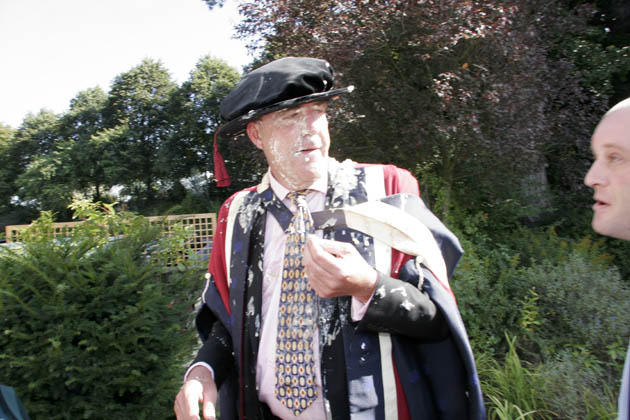
Several elected councillors from the Green Party and their friends dressed up in Jeremy Clarkson jeans and silly wigs.

They looked really frightful.

When Mr Clarkson arrived to collect his honorary engineering degree, a woman called Agent Meringue stuffed a baked Alaska in his face. (Presumably, the baked Alaska had something to do with global warming in Alaska).

The irony is that I subsequently saw at least three Green Party councillors in a 4x4 vehicle.

To add insult to injury, I was nearly knocked over on the pavement outside my house by a car driven by a Green councillor on the eve of the city elections!

Therefore I don't think they are in any position to adopt the moral high ground and state that SUVs are causing global warming.

I'm inclined to think this stunt against 4x4s is gesture politics at its worst.

Our county council leader, Keith Mitchell, tried to undo the damage to Oxford's reputation by inviting Mr Clarkson to dinner.

Not surprisingly the offer was declined. Mr Clarkson probably thinks Oxford is full of lunatics!

SUSAN THOMAS Magdalen Road Oxford  


FOOLISH ADVENTURE

THE foreign secretary, William Hague, is wasting £300m on a war with Libya and a lot of people are questioning his judgement, including senior naval and military commanders.
I feel that he embarked on this foolish war purely to save face and to bolster his ego.
Many politicians have hugely bombastic tendencies.
The reason for this deduction is as follows: Mr Hague sent a rescue mission to the rebels before the war to assist.
The unit was told to go away by the rebels and Mr Hague felt sheepish and foolish.
Mr Hague then persuaded representatives of NATO to back him in deposing Gaddafi.
NATO then embarked on this foolish mission at a time of great financial crisis in Europe. Indeed Italy has already pulled out. Gaddafi was not posing a threat to us and bridges had been made between Great Britain and Libya. Gaddafi’s followers are more Westernised than many of the rebels and speak English.
Frankly, Mr Hague has probably backed the wrong horse.
What our country really needs and desires is a parsimonious, penny-pinching foreign secretary and a generous home secretary.
Instead we have the exact reverse; an extravagant Foreign Office spending a fortune and Home Secretary Theresa May cutting the police force budget.
If the expenditure of the Foreign Office were diverted inland, many austerity measures could be softened.
I feel really sorry for the Justice Secretary Ken Clark. He has been handed a poisoned chalice. He needs to make savings, yet he cannot appear soft on crime.
He is in an impossible situation and looks as though he might be heading for a breakdown.
Mr Hague should trade places with Mr Clark and see how much fun that role is.
SUSAN THOMAS, Magdalen Road, Oxford
 

Friday, 20 May 2011

The Unsolved Mystery of Maddie McCann ; Cuddle Cat the key to the mystery

This high profile case has baffled and perplexed. Clearly the loving Mother had nothing to do with her daughter`s disappearance. She is genuinely bereft. 
A few anomalies warrant investigation.If I were a detective I would ask the following questions.
1. Why did GerryMcCann put the toy cuddle cat in the washing machine??? It was left behind by the alleged abductor and would have had the kidnappers DNA on it. Maddie always slept with her cuddle cat by her.
The crime scene was destroyed by the police incompetence but the cuddle cat remained as a rich source of evidence. The washing of cuddle cat rather implicates the Father Gerry.
2.The night of the alleged abduction was cold and windy. Therefore the cold night air would have awoken sleeping Maddie. As a parent myself I am fairly certain of this.
3. Jane Tanner alleges she saw a sleeping child being carried away. The cold air indicates that the child was either dead or sedated. 
4. Was this person in fact Gerry carrying his daughter who had accidentally died of a sedative given to ensure an uninterrupted dinner party.
5.Jane Tanner was maybe a little inebriated. She saw light trousers. What colour trousers was Gerry wearing that evening??
6. The previous evening the children had cried a lot. Did this lead to a decision to sedate the children??
7. Why did the Mother Kate McCann say that the twins looked as if they had been drugged??
8. The sniffer dogs indicated a death in the apartment. Were they right or were they prompted as claimed by the McCanns.
9. Has Gerry pulled the wool over vhis wife`s eyes in a massive cover up??
10. The dogs detected a scent of death in the hire car that was hired two weeks later. Was the body hidden elsewhere in the interim weeks  and subsequently moved to a more secure place later by Gerry.
11. The old saying " methinks he doth protest too much" could apply to Gerry. As a parent myself I can not imagine going to the Edinburgh fringe festival to publicise the case as Gerry did. It seems too theatrical
12.I have been studying the psychology of lying. It is possible to detect lies by certain markers. In an interview Gerry says that "a person went into an appartment and stole a child". The phrasing used is classic for a fibber. Why??? Because he has distanced himself with detached words. Instead of our appartment he said an appartment and a child instead of our child. This is indicative of guilt.
13. The massive campaign to find Maddie has served as a brilliant smoke screen for a tragic accident. Gerry has now dug himself in too deep with his lie to own up.  He would not want to lose the love of his wife and admit the truth
14. Jane Tanner may hold vital clues. However the man she saw may have been an innocent passer by holding his own child. False memories are notoriously common in witnesses and Jane may have imagined the pink pyjamas to subconciously  please Kate McCann. 
15. Most of the small clues are pointing at Gerry and an accidental death that he unwisely chose to cover up.
Oxford


Thursday, 14 April 2011

Masters essays should be marked Double Blind to avoid bias

The present system of marking essays is open to bias. This is because the second marker can see the comments written on the essay by the first marker. The external marker can also see the remarks and this may lead to bias. In social science the experimental trials are conducted according to a Double Blind Protocol to avoid Experimenter bias. This procedure needs to be implemented in essay assessment. The marks are biased by the first marker. The Conformity Study by Solomon Asch shows how people are prone to copy the predecessor.  Separate sheets of paper need to be given to the three markers. These sheets need to be kept blind from the other markers. At present there is only one piece of paper for all the markers so they do not even need to read the essay if they so choose, but merely sign the paper.Does this laxity occur frequently? Therefore I hope that a proper scientific procedure will be adopted in future to mark Masters essays.

Nuclear Power: Plutonium versus carbon. which is the greater Evil? Professor Hal Lewis is correct

In 2010 I wrote an article stating that a speck of plutonium is infinitely more dangeous than a speck of carbon. Carbon is not the root of all evil as the global warming lobby would have us believe. This fallacy has been adopted by opportunists keen to make a lot of money from propagating this lucrative myth. Such entrepreneurs include Al Gore, George Monbiot and Mark Lynas. The latter have both written books on global warming despite having no scientific qualifications.It is in their financial interests to keep the propaganda going to boost book sales. To further this goal they have been endorsing nuclear power as a low carbon form of energy.Mark lynas even flew(flying and  your carbon footprint Mark?) to Chernobyl to show how safe the contaminated land really is. Carbon was designated a pollutant in Law. This legislation adds weight to the their fallacious argument that carbon is dangerous. It is emphatically not a danger. Indeed the only outcome of carbon dioxide production will be enhanced crop growth.The Green Party lobbied in Europe to designate carbon as a pollutant. Politicians are not scientists. A strategic and economic error has occurred.It will add to our energy bills. Many scientists are frustrated and have resigned such as the brilliant  Hal Lewis. When coal was king , great britain was the richest country in the world. Mining equals wealth.
The Law needs to be repealed . Nuclear power will not ameliorate any hypothesised global warming. It may conversely destroy the Earth and add to dangerous radioactive pollution.

How Workable is the Outright legalisation of Drugs?

This essay will examine the feasibility of legalising drugs completely. It will look at the arguments in support of such legislation that have been put forward such as the raising of revenues for the Government. It will discuss the difficulties of implementing such an ambitious policy in the light of the ingenuity and versatility of organised crime groups that are operating world wide and examine the destruction of environmental habitats by drug cultivation.. There will also be a discussion of countries such as Amsterdam where certain drugs have been decriminalised and the resultant effect on the over crowded criminal justice system. The essay will look at the problem in the context of widely used legal intoxicating substances such as alcohol and prescribed medications that are linked with health and societal harms. It will briefly examine the historical context of drug use with the aim of highlighting the ubiquitous tendency of mankind to dabble in consciousness altering substances throughout the history of civilisations on our planet. The essay will conclude that the avarice of organised crime groups will most likely make total legalisation of drugs an unworkable option. Such criminal enterprises will aim to avoid paying taxes as they operate outside of the law to maximise their profits.
This year in November 2011 there will be a working party hosted by the Beckley Foundation with the Parliamentary Group on Drug Policy Reform in the House of Lords to discuss alternatives to the failed war on drugs (Beckley Foundation 2011). The illegal drugs trade makes £200 billion a year and so it might prove lucrative to assess the feasibility of legalising drugs such as cannabis with the aim of treating the business as a taxable concern. The Transform Drug Policy Foundation is also supportive of a less penal and more rational drugs policy and argues HIV interventions such as needle exchange would benefit from a harm reduction approach (Transform 2009). Economists such as Milton Friedman endorse a liberal free market philosophy towards the drugs and alcohol trade but with certain caveats such as age restrictions (Friedman & Szasz 1992).
Campaigning groups such as Liberty say that drug users are self harming rather causing harm to others and therefore the state has no right to intervene (Liberty 2001). From a criminal justice point of view the criminalising of drug users has caused a crisis of over crowding in prisons world wide. This is especially the case in countries such as Thailand that implement draconian drugs legislation. Indeed many countries in the Far East treat drug trafficking as a capital offence. Yet there is a long history of opium use going back to the Neolithic era when opium was used by early physicians such as Hippocrates (McCoy 1972). The stimulant cocaine was isolated from the coca leaf in 1858 and was used in Coca Cola in the 1890`s (Inciardi & McElrath 2001).
In the U.K. the Justice Secretary Ken Clarke has called for fewer custodial sentences in an attempt to ease the crowded prison population in his Green Paper (Hanson 2011). Lord Leveson has been requested to implement a leniency in the sentencing guidelines to facilitate this reduction in prisoners. Clearly the decriminalising of drugs would free up a substantial number of prison places.
At present alcohol is a perfectly legal intoxicant and yet the consumption of alcohol may indirectly lead to a custodial sentence. This is the case when inebriated consumers commit acts of violence or criminal damage while under the influence. The National Alcohol Harm reduction strategy (Cabinet Office Strategy Unit 2004:44) states that alcohol is a major contributor to crime. The breach of an ASBO or a DBO (Drinking Behaviour Order) that prohibits drinking in a public place may also result in a custodial sentence. Therefore since legal substances may result in a custodial sentence this somewhat negates the argument that legalising drugs will completely free up the crowded CJS. The offence of dangerous drug driving will still apply as does the offence of drink driving (South 2007). Indeed there have been numerous campaigns against the dangers to the public from those who take to the roads in an intoxicated state.
Legalising a substance may raise revenues but the risks to innocent victims remains as acute as ever. Therefore the legalisation of mind altering substances should not be regarded as a utopian panacea. There will always be a need for public education of the dangers via advertising campaigns. Just as alcohol is a central nervous system depressant that may slow reaction times, hallucinogens such as L.S.D. may cause visual disturbance that will present a hazard to safe driving. Legal systems such as Sharia Law completely prohibit alcohol and drug use but this outright legislation is often circumvented in private drinking parties in Saudi Arabia. If drugs were to be completely legalised in England and Wales there would still need to be policing of drivers who are under the influence. There was a recent high profile drug driving case where the singer George Michael was sentenced to prison for demolishing a shop front while under the influence of cannabis. He emerged from prison stating that he would not be taking drugs again. This assertion provided some support for the custodial sentence that he had endured since he had clearly learnt a harsh lesson.
Notwithstanding the issue of road safety there is an argument that possession of drugs should perhaps be decriminalised in order to free up space within the Criminal Justice System. Baroness Stern states that drug laws have pushed up prison numbers to unsustainable levels (Beckley Foundation.2011). The possession of drugs such as cannabis could be dealt with leniently or not at all if the drug was completely legalised. Countries such as Amsterdam have not seen a dramatic increase in smoking cannabis since a permissive stance was adopted. Indeed maybe young rebels are attracted to a substance because it is naughty and illegal. This attraction would not be present if the drug was available to be purchased in a shop.
In California there are retail outlets that sell numerous varieties of medical marijuana. The crop generates huge profits and is California` s biggest crop (Pugh 2011). This modern day phenomenon echoes the American 1914 Harrison Act where a doctor could prescribe narcotics or cocaine . It is now relatively easy for a “patient” in California to get a prescription for this neatly packaged product. There are therapeutic properties of cannabis that have been shown to ease the muscular spasms of multiple sclerosis sufferers. In the U.K. there is a spray called sativex that eases the symptoms of some MS patients. In California the concept has been taken much further and a whole array of marijuana products may be purchased via legitimate retail outlets that are presumably paying taxes. Dutch coffee shops allow cannabis but critics say that they attract the wrong sort of clientele or drug tourists to the area (Drugs Forum 2005).
Smoking any substance, legal or not, undoubtedly harms the lungs. Smoking also contributes to cardiovascular disease. Any increase in smoking will increase the burden on NHS or health service providers. The International Harm Reduction Association aims to reduce adverse consequences of mood altering substances that impact on health and society. Therefore legalising a substance such as cannabis will not lessen societal harms. A study indicated that in the hour after smoking a joint users were five times more likely to suffer a fatal heart attack (Duckworth 2001). A New Zealand study found smoking one joint of cannabis was equivalent to twenty cigarettes as a carcinogen (Reuters 2008). Cannabis comes in many varieties including skunk that contains higher levels of tetra hydrocannabinol known as THC. There have been genetically modified seeds to produce higher levels of THC. This has resulted in genetically susceptible users in becoming paranoid and psychotic. A chef high on skunk stabbed Abigail Witchells in the neck leaving her in a wheel chair (Howie 2005). A paranoid psychosis may cause the sufferer to believe that strangers are mocking and laughing at him: this can lead to acts of violence. Would the outright legalisation of drugs help ensure the labelling and quality control of skunk and thus prevent such tragic occurrences? Perhaps if cannabis were to be legalised then certain varieties that were dangerous would not be cultivated. Here we have come full circle in the discussion. The dangerous varieties of super strength skunk that were not cultivated or sold would then be illegal.
It seems that there is a market in this country for the Californian model and it might raise some much needed revenue. However if a consumer were to become psychotic and kill after a purchase who would be held legally liable? Would the victim` s family sue the shop keeper or hold the Government liable? In the Middle Ages a Moorish sect became known as the hashishin (Burman 1987).. They committed murderous acts fuelled with bravado from smoking hashish. This is where the term assassin originates in our modern day thesaurus. Hence the smoking of hashish or cannabis does not always result in a mellow mood as is commonly assumed. It seems that while certain cannabinoids produce a calm mellow mood other constituents such as THC produce a rise in dopamine and aggression.
So far the discussion has focussed upon cannabis as an example of an illegal drug. There are countless varieties of illegal drugs such as cocaine, a derivative of the coca leaf. This leaf is chewed by the indigenous people of South America for endurance in the high thin mountain air. The problem started when mass production started for Western use. This has led to destruction of valuable plant habitats and a loss of biodiversity as forests are felled to make way for coca cultivation (Science News 2011).. If cocaine were to be completely legalised this environmental problem might actually become exacerbated. At the moment a battle is being waged to prevent cocaine cultivation and crops are destroyed by Government agencies. South America is home to a unique biodiversity that is vital for the production of therapeutic drugs to fight cancer and disease. A lot of the Amazon rainforest has been felled leaving endangered species without a habitat. Therefore the widespread use of land to cultivate drugs whether legal or illegal is clearly inadvisable. Cocaine use is extremely high in the U.K. and we have been dubbed the cocaine capital of Europe causing concern to Professor Les Iverson (Home Office 2010) Respectable bankers use it and traces have been found in the House of Commons. Even George Osborne was pictured in the press before a line of white powder. Some users have suffered fatal heart attacks. A ban on cocaine would benefit the environment and the NHS but the drugs barons would easily circumvent such a ban. Many drugs barons are armed to the teeth. There have been thousands of drug related deaths in Mexico during the last decades (Gallagher 2011). We should consider ourselves fortunate that this scale of slaughter is not occurring here in the U.K .The vast and lucrative profits to be made from cocaine has led to wars over territories known as patches. A successful ban on cocaine cultivation would save many lives but it is impossible to enforce due to the numbers of criminals. There are probably more members of organised crime gangs than there are police members. There is also the problem of police corruption and bribery. Drug cartels may become very rich and powerful through this business. It is widely accepted that there is corruption in high circles that include politicians and law enforcement officials (Bowden 1998). Therefore an outright ban would be difficult to enforce and the converse outright legalisation would create environmental and social harms. This leaves us in the present day situation where a losing battle is being waged in America against the drug cartels.
The situation is markedly more civilised in Europe and yet there is a symbiotic relationship. Any drug user is indirectly supporting the crime syndicates that have killed countless victims (Associated press 2011). The cartels generally trade their wares so that cocaine, cannabis and heroin will all be exchanged by /the different gangs. Heroin grows in Afghanistan so Asian gangs will probably trade with South American cartels in a transnational operation. This is organised crime. These syndicates are not likely to co-operate with the laws of a land.
Alcohol and cigarettes are legal products and yet they have been smuggled by gangs keen to avoid custom duties. There will always be a black economy that thrives in dealing with these desirable black market items. There have been cases of price fixing collusion occurring in legitimate NHS medicines (Bowers 2007). Even companies such as Astrazenica have been tainted by collusion and price fixing (Duke 2010) Therefore if drugs were completely legalised such covert trading would probably still occur. Organised crime permeates the globe. For example the Triads have operated for centuries in China and in Japan the Yakuza became very prosperous and acquired a lot of real estate. In Italy the Mafias are heavily involved in construction property business and were the most profitable business in 2009 (Krause-Jackson 2009) . In the 2010 John Harris memorial lecture U.K. Sir Paul Stephenson said that there are around six thousand organised crime groups currently under the police radar (Police Foundation 2010). This is a huge number that indicates that the numbers game is being won by the crime syndicates. If all known drugs were legal they would doubtless find a way to subvert the regulations.
It has been suggested by some police officers that it would free up some of their man power if drugs were legalised. Again in the light of the previous discussion this would seem overly optimistic. There is an economic argument that legalising drugs would save money as the present judicial system is costly (Mishan 2001).The British Medical Journal carried an article stating that some legalisation will help and is preferable to prohibition (Smith 1995). This is not the same note bene as an endorsement for an outright and complete legalisation of drugs.
There has also been an argument put forward that quality control of drugs could be maintained if they were legalised and dangerous adulterants could be avoided (Nadelman 1989) . Just as bottles of wine and beer state the percentage of alcohol on the label so cannabis could be labelled according to THC content. Immediately one can envisage the logistical problems of labelling the narcotics, opiates, psychedelics, stimulants and other illicit drugs such as MDMA or ecstasy. A complicated and expensive team of quality control scientists would need to be employed by the crime groups who are currently trading. Would these people wish to come out into the open? If others took over their business enterprise they might not be pleased and repercussions might ensue.
In the legitimate pharmaceutical industry there have been countless scandals and lax quality control (Braithwaite 1984).It has been reported that many deaths result each year from prescription drugs and accidental overdoses (Harmon 2010). The use of human guinea pigs for drugs trials has attracted censure and the dangers were highlighted by the TeGenero scandal (Rosenthal 2006). The drug TGN412 was trialled by Parexel and volunteers were damaged by a cytokine storm in their immune system. This example indicates difficulties in the testing procedures of drugs and the recruitment of trial subjects.
Recently some pharmaceutical companies such as Pfizer have announced that they will relocate to China which has been home to many consumer scandals such as fake vaccines (China Post 2010) and the melamine baby milk adulteration (Wong 2008). This shows that even legal operations may be prone to illegal malpractice. Therefore the outright legalisation of drugs might not prove to be the panacea to the quality control problems such as the purity and strength of heroin and cocaine. Organisations such as Trading Standards,the FDA and the IMPACT Counterfeit Taskforce might find their resources becoming over stretched by consumer complaints. There have been cases of prescription frauds committed by retail pharmacists (Quinney 1963) and this might occur with legalised drugs.
At present alcohol is sold in supermarkets on shelves visible to all shoppers. Would the same way of selling the merchandise be used for the legalised drugs and might some consumers object to this? Restrictions of sale to certain age groups would presumably be enforced as they are for alcohol at present in the U.K. It has been reported that youngsters under age have got hold of alcohol as well as illegal drugs and therefore legalising drugs will not prevent this problem.
The sheer logistics of legalising all drugs would be enormous as new designer drugs are constantly being invented in laboratories all over the world. While some drugs originate as cultivated crops many others such as MDMA and Ivory Wave are chemical products manufactured in covert operations in dubious places. Even if all known drugs were to be legalised there would most likely be a whole new wave of illegal drugs flooding the markets from these back street operations. There has been a huge increase in legal highs and many of these have been found to contain worrying levels of psychoactive substances. The openly sold legal high drug Spice caused some users to become paranoid and so was legislated to become illegal (abc15.com 2010). This issue of new products that are constantly being invented shows how difficult it would be to legalise all drugs. There is also the serious problem of counterfeit drugs. Many pharmaceutical drugs such as those to treat diabetes and cancer have been found to be counterfeit versions of the genuine product (WHO 2009). The identical packaging complete with hologram can make detection difficult. This widespread fraud could affect legalised drugs so making them no less safe than illegal drugs.
Legalising highly addictive drugs such as heroin might tempt more people into trying the drug with consequent long term health problems. There are people who do not take drugs because they do not wish to break the law and possibly this sample might try drugs if they were legalised. More drug users would lead to burdens on health services that already have a lot to cope with regarding alcohol and drug overdoses. Professor Nutt said that ecstasy was safer than horse riding and there was resultant media and public censure. The Labour Government was criticised by some for dismissing him (Beckley Foundation 2011).
There have however been tragic deaths from the drug ecstasy which is taken for its pleasure serotonin boosting properties. Many drugs act on the brain neurotransmitter systems with potentially dangerous outcomes. Legalising drugs would not prevent accidental drug related deaths that occur due to individual metabolic sensitivities or from drinking too much water as in the case of Leah Betts (Laurance 1995). Some in favour of legalisation would like drugs to be covered by a pharmacy and poison control model. However the pharmacy industry is rife with malpractice (Braithwaite 1984) and tragic mistakes such as Thalidomide (Punch 1996). There have been numerous recalls of drugs such as Avandia for diabetes (Defective drug index 2011)and problems linked to Prozac including a homicide (Stipp 2005).
In 1989 the Bush administration appointed a zero tolerance Drugs Csar named William Bennett. He warned of a new generation of super predators and street criminals (Bennett et al 1996). The US drug Czar, waged war on drugs and said that drugs destroy human dignity, yet the predicted crime rise did not emerge and the era known as the “Great American Crime Decline” emerged (Zimring 2007). James Inciardi argues that many American clinicians feel that legalising drugs would be dangerous (Inciardi 1999). Adrian Barton discusses legislative and policy developments in chapter 9 of Illicit Drugs (Barton 2003). These include British policies such as Tackling Drugs Together (1995) and Tackling Drugs to Build a Better Britain (1998) which aim to reduce societal harms. Barton also reviews the liberal drugs policies of European countries such as the Netherlands and harsh Swedish policies to contextualise the British approach. Barton states that 90 per cent of ecstasy consumed in the U.K. originates from the Netherlands. Therefore the outright legalising of dance drugs like these would require international co-operation which might be difficult to financially implement and disputes could arise. However a vast amount of crime processed in the British criminal justice system relates to cannabis possession (Barton 2003, Chapter 3) and this is one area that could be freed up by legalisation. While wealthy drug consumers do not need to steal to fund their habit this may not apply to the disadvantaged. The debate between the link between drugs and crime is widely covered by Philip Bean in his book on drugs and crime (2008) and it is not a straight forward one.
To conclude, the outright legalisation of drugs would prove problematic and would not necessarily improve consumer safety as corruption is rife in industry (Slapper & Tombs 1999; Tombs & White 2007). Huge numbers of deaths are already linked to legitimately prescribed drugs such as codeine (Times report 2007) and barbiturates such as Valium and the counterfeit pharmaceutical problem is absolutely huge (WHO 2009). Price fixing and collusion is a problem to be considered .The Chief Constable of North Wales, Richard Branstrom, said it was inevitable that drugs would be legalised in the next 10 years and his 2007 report highlighted how drug use and attendant crime has soared in recent years (Brunstrom 2007). Brunstrom calls for a pragmatic policy that is based on evidence and for the present prohibitionist stance to be swept away. The Police Authority calls for a repeal of the Misuse of Drugs Act 1971 in this 2007 report. It could be be replaced by a Misuse of Substance Act based on a hierarchy of harm. Similarly the Police Foundation Inquiry said that eradication of drug use is not achievable (1999). The deleterious environmental impact of increased cultivation of drugs need to be considered if they were to be completely legalised. Although outright legalisation of drugs might prove inadvisable an incremental approach might prove feasible as in decriminalisation of cannabis possession. Words 2900


References:
Associated Press (April 13 2011) “Number of Bodies Found Mexico State rises to 122”,http://www.npr.org/templates/story/story.php?storyId=103181125accessed 2011-04-14
Abc15.com (2010) Feds plan to ban synthetic marijuana “spice” http:// www.abc15.com/dpp/news/region/_central_southern_az/tucson/feds-plan-to-ban-synthetic-marijuana-“spice” accessed 2011-04-11
Associated press ( April 13 2011)
Barton, A. (2003) Illicit Drugs, London: Routledge.
BBC News (July 12 2010) “U.K. Police Response to Organised Crime Attacked” http;// www.bbc.co.uk/news/10601509 accessed 2011
Bean, P.T. (2008) Drugs and Crime (3rd edition) Cullompton.
Beckley Foundation (2011) Former Heads of MI5, CPS and BBC all say- the War on Drugs has Failed, in Beckley in the media slider, global policy news, latest news., http://www.beckleyfoundation.org/2011/03/21/former-heads-of-mi5-cps-bbc-say-the-war-on0drugs-has-failed accessed 2011-04-11
Bennett, W. (1989) “Drugs policy and the intellectuals”, speech delivered at the Kennedy School of Government, Harvard University, 11 December accessed 2011-04-11
Bennett, W.J., Dilulio, J.J., and Walters, J.P.(1996) Body Count: Moral Poverty and how to Win America`s War Against Crime and Crime and Drugs, New York: Simon and Schuster.
Bowden, J. (1998) Juarez: The laboratory of our future, New York: Aperture Foundation.
Bowers, S. ( June 2 2007) “Net closes on Firms draining NHS lifeblood”
Guardian report
Braithwaite, J. (1984) Corporate Crime in the Pharmaceutical Industry, London. Routledge & Kegan Paul
Brunstrom, R. (2007) “Drugs Policy: A radical look ahead?” Paper prepared for North Wales Police Authority http://north-wales.police.uk/portal/files/folders/3817/download.aspx accessed 2011-04-10
accessed 2011-04-11
Burman, E. (1987) The Assassins, Wellingborough: Crucible
Cabinet office Strategy Unit (2004) Alcohol harm Reduction Strategy in England: London: Cabinet Office
China Post ( Dec.21 2010) “China jails eight for peddling counterfeit vaccine” http:// www.chinapost.com.tw/china/national-news/2010/12/21/284487 accessed 2011
Defective Drugs Index (20110 Avandia Drug recall http:// www.adrugrecall.com/avandia/diabetes.html accessed 2011
Drugs Forum (2005) Drugs coffee shops attract Belgianshttp://www.drugs-forum.com/forum/showthread.php?t=13158accessed 2011-04-14
Duckworth, L. (12 June 2001) “Smoking cannabis puts muddle-aged users at higher risk of heart attack” The Independent Health News
Duke, S. (Dec.4 2010) “Astrazenica Hit by EU Collusion Claims” This Is Money
Friedman, M. and Szasz, T. (1992) On Liberty and Drugs. Washington DC: Drug Policy Foundation
Gallagher, P. ( Jan.9 2011) “ Bodies decapitated in Street Killings Blamed on Drug cartels” The Observer.
Hanson, C. (Jan. 2011) “Kenneth Clarke`s Green Paper “Sentencing and Rehabilitation”, Inside Time.
Harmon. K. ( April 6 2010) “Prescription Drug Deaths increase Dramatically” Scientific American
Home Office (March 3 2010) Home secretary (Alan Johnson) letter to Professor Les Iverson regarding the review of the harms of cocaine.
Howie, M. (Nov.23 2005) “Man Confessed to Abigail Attack”, The Scotsman.
Inciardi, J. (1999) Legalising drugs: would it really reduce violent crime?, in J. Inciardi (ed) The Drug Legalisation Debate (2nd)edition). Thousand Oaks, CA: Sage Publications, pp. 55-74.
Inciardi, J. and McElrath, K. (2001) The American Drugs Scene, 2nd edition, Los Angeles: Roxbury
Krause-Jackson, F. ( Jan. 30 2009) “Italian Mob Revenue Surges to $167 billion from 2007 (Update 2) Bloomberg http://www.bloomberg.com/apps/news?pid--newsarchives&sid--aJtXWLHPauOY accessed 2011
Laurance, J. (Nov.22 1995) Ecstasy safety; leah Betts Died of Drinking Water to counter drugs effects” The Times
Liberty (2001) The Government `s Drug Policy,. Is it working? Submission to Home Affairs Select Committee, September.
McCoy, A.W. (1972) The politics of heroin in South East Asia, New York: Harper and Row
Mishan, E.J. (2001) “The staggering costs of drug criminalisation” Economic Affairs, 21(10. pp.37-42.
Nadelman, E. (1989) “Drug Prohibition in the United States: Costs, Consequences and Alternatives”, news item California sells marijuana in shops legally, 245, 939-47.
Police Foundation (July 12 2010) Sir Paul Stephenson Delivers the John Harris Memorial lecture www.police-foundation.org accessed 2011
Police Foundation (1999) Drugs and the Law: report of the Independent Inquiry into the Misuse of Drugs Act 1971 (the Runciman report) London Police Foundation www.police-foundation.orgaccessed 2011-04-10
Pugh, T. (2011) “Weed spreads wealth, medical marijuana grows into huge national industry,” the Columbus Dispatch.com http:// www.dispatch.com/live/content/insight/stories/2011/04/03/weed-spreads-wealth,html?sid--101) accessed 2011-04-11
Punch, M (1996) Dirty Business, London: Sage.
Quinney, R.C. (1963) “Occupational Structure and criminal behaviour: Prescription Violations by Retail pharmacists” Social problems 11 , 179-85
Reuters (2008) “Cannabis bigger risk than cigarettes study” http:// www.reuters.com/article/2008/01/29/us-cancer=cannabis-idU5HKG10478820080129accessed 2011-04-11
Rosenthal, E. ( April 7 2006) “When Drug Trials Go Horribly Wrong” New York Times.
Science News (2011) “Cocaine Production Increases Destruction of Columbia`s Rainforests” http;// www.sciencedaily.com/releases/2011/01/110128144723.htm accessed 2011-04-11
Slapper, G. and Tombs, A.S. (1999) Corporate Crime, Harlow: Longman.
Smith, R. (1995) The War on Drugs; Prohibition isn`t working-some legalisation will help, British Medical Journal, 311 pp.1655-6 http://www.bmj.com/content/311/7021/1655,extract accessed 2011-04-10
South, N. (20070 “Drugs, Alcohol and Crime”in M.Maguire et al (eds) The Oxford Handbook of Criminology, 4th edition. Oxford:Oxford university Press.
Stipp, D. (Nov.28 2005) “Trouble in Prozac” Money Fortune Magazine
The Times (Aug. 18 2007) “Codeine Danger Alert After breastfed Child dies in US”
Tombs, S. and White, D. (2007) , Safety crime Cullompton: Willan.
Transform Drug Policy Foundation (2009) After the war on drugs: Blueprint for regulation, Bristol ww.tdpf.org.uk http://transform-drugs,blogspot.com accessed 2011-04-10
WHO (2009) World Health Organisation: Media Centre Medicines : Counterfeit Medicines Factsheet No. 275

Tuesday, 8 March 2011

MISCARRIAGE OF JUSTICE: BAMBER CAFELL APPEAL NOT UPHELD

This case portrays the Criminal Justice System in a  most inefficient and inept light. The crime scene was disturbed by hordes of marauding police officers . The police even allowed a firearms training unit to enter the murder crime to conduct a training exercise using the corpses. The murder weapon  and murdered bodies were moved around as  clearly evidenced by the photographs.
Initially the murder was held to be a tragic consequence of a Mother who had gone beserk and killed her own children and parents before killing herself. Subsequently the brother was convicted of the murder on the hearsay of a bitter ex- girlfriend who was nursing a grievance against Bamber Cafell. She said that he did it to get the inheritance. 
Nowadays there is sophisticated software known as voice recognition analysis that can detect if a person is lying. This VRA software is used by actuarial insurance assessors. This girlfriend`s statement needs to be placed under such scientific scrutiny to ascertain its veracity. This has not been done and therefore  the statement amounts to no more than hearsay. As evidence it is therefore worthless. It seems that Bamber Cafell has been convicted purely because the jury and Judge did not like the look of him. This is known as the negative halo effect. 
The sister known as Bambi Cafell suffered with paranoid schizophrenia. It is very common for sufferers of this disorder to commit violent or murderous acts. The list is vast. Recently a paranoid Mother named Theresa Riggi was convicted of stabbing her three children to death. A paranoid Father also tried to kill his children by driving into a river after an argument with his ex partner. A father jumped from a hotel balcony with his two children after rowing with his wife. The list of children murdered by insane and temporarily insane parents is sadly a lengthy one.
On the night of the killings, there had been an argument between the Mother Bambi Cafell  and her foster parents about the children. Arguments about children has been shown to be a trigger for irrational and murderous behaviour towards infants. Bambi may have been driven to a precipice of homicidal insanity by the inflammatory comments. This would have been exacerbated by the time of the dispute. It was very late and she would have been over tired and irritable. Being of a paranoid nature she would not take criticism well. 
The conclusion of this analysis is that the Appeal Court has been negligent. They have made a judgement based on prejudice and stereotypy. A similar scenario has occurred with poor Amanda Knox who is bearing her trial with great fortitude.

Monday, 7 March 2011

CRIMES OF THE POWERFUL


Crimes of the Powerful
Criminals wear many masks. The archetypal mask of Highwayman Dick Turpin, worn by modern day assailants such as burglars and hoodies epitomises the public perception of dangerous street criminals.
However a vast amount of crime is cloaked in an expensive suit of respectability and legitimate authority rather than a bandit` s mask. This invisible cloak of crime is worn by respectable corporations who can inflict serious yet indirect damage on society and its component individuals.  Given the arbitrary nature of the definition of crime (Christie 2004), as well as the privileged status of those who define it this essay will proceed to delineate the relationship between crimes of the powerful as opposed to the more common petty street crime that frequently hits the headlines.
This essay will delineate some of the ingenious crimes committed by respected institutions such as banks, pharmaceutical companies, elected politicians and respected institutions and corporations in which the public often place a misguided trust. It will conclude that we must remain ever vigilant of legitimate authority, including the police and State, in order to protect ourselves. Just as we would take reasonable precautions to protect ourselves from street crimes such as muggings and burglary so we should critically regard the respectable institutions that form the bedrock of our society as being the potential perpetrators of invisible crime. This essay will delineate the relationship between crimes of the powerful as opposed to the more common street crimes such as muggings that usually hit the headlines.
 For instance it has been calculated by the Audit Commission that each and every family in this country will eventually pay in the region of £40,000 towards the bailout of the reckless banks that were bailed out during the recent 2008 banking crisis. A handbag snatcher or street mugger would rarely escape with such a vast sum! Such sophisticated malfeasance is understandably hard to quantify and pin down and yet it yields extremely high dividends in comparison to the low dividends yielded by common street crime.
 Criminals come in all shapes and sizes and from every strata of society. Status driven acquisitive crime has been discussed in many studies including those on corporate or workplace crime. The term “white collar crime” refers to this type of crime and was first coined by Edwin Sutherland in 1939. At the time this was a very new and exciting concept as it had previously suited the wealthy genteel Edwardians to look down upon the impoverished criminal classes. This enabled the ruling elite to exert control over the proletariat rabble and thereby protect their financial interests. This idea of inherent privilege was also examined at length in the radical works of Marx and Engels (Marx & Engels 1848). Karl Marx felt that wealthy capitalists exploited the lower classes. It suited the elite plutocracy to label the poor as bad.
 Laws of the land may be construed as the normative structure of the dominant group (Sellin 1938).Thus we have a criminal justice system that is replete with Justices and Magistrates emanating from a background of privilege and wealth. The seminal study by Edwin Sutherland helped bring about a shift and a change of perception. Criminals it seems could be ordinary and hardworking respectable individuals who dress smartly for work in a white collar shirt and a neat suit. They attract little attention since they are legitimately at the scene of the crime in contrast to a trespassing house breaker. According to routine activity theorists the propensity to criminal behaviour is normal and driven by opportunism and an easy target (Cohen & Felson 1979; Clarke & Felson 1993; Felson 1994). This theory may explain why recorded crime rose during the last century as prosperity grew bringing more opportunities. Routine activity theory also sits well with the incidence of occupational and corporate crime where temptation is ubiquitous (Punch 1996 p.213).
 As well as the individual acting alone, the company as a separate entity can act in a criminal way (Box 1983). Studies on group polarisation known as the “risky shift” might explain why such corporate groups behave recklessly as in the case of the fatal Challenger decision (Pruitt 1971).  Sutherland discusses criminal acts by American utilities companies such as General Electric in his book on white collar crime (Sutherland 1949; 1983). Clearly these sharp business practices are motivated by greed rather than need. Indeed since white collar criminals are in employment they cannot use the excuse of pressing poverty for their actions.
A more recent case of corporate crime was the Enron scandal that erupted in 2001 in America that involved power cut malpractice with utility   companies. Enron was a hugely successful company and listed by Fortune Magazine as being the most innovative company from 1996-2001. Enron employed a creative accountant, Andrew Fastow, who used numerous tricks to hide Enron` s liabilities.  This seemingly robust company encouraged investors to buy shares in a company that was in fact hiding huge liabilities.
The dishonesty of Enron was not confined to its creative accounting techniques. Enron had given large donations to the political campaign of a Californian Senator, Phil Gramm, who was duly elected. In return he passed legislation in 2000 to deregulate electricity commodities. This was beneficial to Enron who owned many power utilities. Following the legislation California had 38 serious rolling blackout power cuts. These were engineered by Enron to maximise profits. Any one power cut can seriously endanger life since power is essential for hospitals. This wholly unacceptable behaviour of corporations has been discussed by Stephen Box  who asserts that one is seven times more likely to be killed by corporate negligence than a common street criminal (Box 1983).
 A concerned whistle blower came forward in 2001 (BBC News 2002). Investors rushed to dump their shares. A white knight rescue attempt by another company failed and Enron filed for bankruptcy.
Another high profile case in the U. K. was that of the Polly Peck Company. This large concern was owned by tycoon Asil Nadir. He allegedly fleeced investors of millions of pounds and then fled the country to escape justice. He has recently returned to face justice, hoping that the current Government will assist a once generous Tory donor. The SFO have been preparing a case against him (Gammell 2010). This still wealthy tycoon has been tagged and must obey a strict curfew in his penthouse apartment. One may speculate that some of the perpetrators of outrageous financial crimes might have suffered extreme deprivation as children resulting in poor self control (Gottfredson & Hirschi 1990).
An industry that is rife with corruption is the Pharmaceutical industry (Braithwaite 1984). In 2002 The Serious Fraud office (SFO) launched an eight year long investigation into five drug companies known as Operation Holbein (SFO 2002). More than a million computer drives and files were seized from the homes and offices of the six companies involved (Bowers 2005). The police arrived with search warrants for six pharmaceutical companies but no arrests were made. The six companies accused were Generics U.K. Ltd., Kent Pharmaceuticals Ltd., Regent-GM Laboratories Ltd., the Gold Shield Group Plc., Norton Healthcare Ltd., and Ranbaxy U.K. Ltd.
The SFO accused the drug companies   of conspiring to defraud the NHS through a price fixing cartel. Unfortunately for the SFO the case was thrown out of court on a technicality by Lord Justice Pritchard (Goswami 2011) leaving an eight year investigation in tatters. The reason that the case failed was that the indictment by the SFO was for price-fixing and price-fixing in itself is not a criminal offence. This defeat in a Court of Law has also has caused speculation as to the future of this Government body. The case was a very expensive one but all is not lost  fortunately  as the NHS has managed to recoup £34 million from the drug companies with the assistance of the Department of Health with civil as opposed to criminal proceedings. The civil proceedings were simple because the drug firms did not have a case and could settle without accepting liability. It is rather touchingly poignant that the operation was probably named after a “portrait of a gentleman” by the artist Hans Holbein that hangs on the wall of the office of the SFO deputy chairman. If only there were more true gentlemen in the unscrupulous world of business!
 The SFO were right to attempt to bring criminal proceedings against these powerful companies that were attempting to milk the NHS of billions of pounds with the price-fixing of drugs. These included Warfarin that is used to thin the blood in those with thrombosis (Bowers 2005). Altogether at least thirty drugs were involved at great expense to the struggling NHS. Although the SFO was unsuccessful in this case it seems that harsh criticism of this taskforce by journals such as The Lawyer is unmerited.
 The SFO has a long list of successful prosecutions to its credit. These include the sentencing in 2008 of five men involved in a ten billion US dollar worldwide Ponzi scheme. Two of the men were former British policemen and one was even a lawyer! The fraudsters were selling gold shares, a commodity, that had did not exist and had not even been mined. Ponzi schemes are fraudulent investment scams that pay the investors dividends using other investors` money rather than from the profits of the actual business venture itself. In effect they are robbing Peter to pay Paul. In some cases there is not even a genuine business venture and the whole edifice is as flimsy as a pack of cards. It is difficult to comprehend that there are so many criminals, such as Bernie Madoff, that are willing to perpetrate such scams upon naïve and trusting investors.
The lucrative returns of pharmaceuticals make them an attractive target for counterfeit by organised powerful crime groups. These are medicines that are deliberately and fraudulently mislabelled as to their identity and their source (WHO 2010).Use of such products can result in treatment failure and death. Both branded products and generic drugs are exposed to counterfeiting and may have identical packaging to the genuine product complete with the hologram. This level of sophistication can make detection difficult. They may deceive health professionals, pharmacists and hospitals. These counterfeit drugs may contain some or no active ingredients. They are found all over the world and eliminating them presents a huge public health challenge. It is often impossible to trace the source of these dubious products. Counterfeiters are extremely flexible in the methods they use and may repeatedly change their methods to prevent detection. This means that there is a paucity of data as to the real extent of the problem. The WHO estimates that one in ten of all medicines taken may be counterfeit. However the extent of the problem is disputed by statisticians and may be higher or lower (Baker 2009; Bialik 2010).
Some of the detected counterfeit drugs detected to date are Viagra for erectile dysfunction, Xenical for obesity, Zyprexa for bi-polar disorder, Lipitor to lower cholesterol, Metakelfin for malaria and numerous painkillers and over-the-counter products. A deadly counterfeit diabetes drug containing six times the requisite dose resulted in several deaths in China recently (WHO 2009). The U.K was flooded with counterfeit drugs in 2007 and this led to the eventual arrest of Kevin Xu, a citizen of the people `s republic of China and head of a large counterfeiting enterprise. The MHRA seized 40 000 of the estimated 70 000 fake products and the rest were lost in the supply chain. The medicines involved were those used to treat prostate cancer, schizophrenia and stroke. The legislation to deal with his problem is the Offences under the Medicines Act 1968 and the Trademarks Act 1990. The maximum sentence under the former is two years and under the latter the maximum sentence is ten years. The MHRA prefers to prosecute under the Trademarks Act for this reason. However this is not always easy as the purpose of this Act is to protect the intellectual property rights of the company rather than protect the safety of the consumer. Counterfeit medicines tested by the Medicines and Healthcare products Regulatory Agency (MHRA) have been found to contain rat droppings and brick dust according to their head of enforcement Mr. Deats .
Karl Marx felt that wealthy capitalists exploited the lower classes in order to remain at the top of the metaphorical pecking order (Marx 1859; 1904). This exclusive situation is very much present in society today (Chambliss 1975; Young 1999).Today many wealthy capitalists endeavour to do this by employing canny accountants to give advice on ways of avoiding paying taxes to the government. Numerous tax havens exist such as the Cayman Islands and this has recently received a lot of media attention in the light of austerity budgets. Ordinary hard working tax payers are becoming increasingly angry about flagrant tax avoidance. There is a militant organisation called UK Uncut that protests against tax avoidance by companies such as Top shop (BBC News 2011). Rather embarrassingly for David Cameron, the boss of Top shop, Philip Green, was recently employed by him as an image consultant.
The wealthy donor to the Conservative Party, Lord Ashcroft, was also exposed as hiding all of his assets offshore. The fact that he donated huge amounts to the election campaign is especially galling. Furthermore a recent report by the respected Institute of Fiscal Studies has shown that the draconian austerity cuts are being disproportionately shouldered by the poorest sector of society (IFS 2010). This is manifestly unjust and the electorate is becoming increasingly restless with the Coalition government as recent street demonstrations have shown.
The general public is also very disenchanted with the behaviour of avaricious bankers who have been rewarding themselves with huge bonuses despite the collapse of many banks through mismanagement. This behaviour is beyond the comprehension of most ordinary mortals who are having moral panics (Cohen 1973; Garland 2008). The criminologist David Nelken said that the best way to rob a bank is to work in one (Nelken 2007). Several high profile banks have collapsed recently. These include Northern Rock, which precipitated the first run on a bank for decades. In America at least twenty eight banks collapsed including Lehman Brothers in 2008.
What on earth is going on here one may ask? Many say that the bankers gave out too many NINJA loans in America, NINJA being the acronym for no income, jobs or assets. This was known as the sub prime loan crisis. There is no doubt that bankers have been behaving recklessly in order to earn their sales commissions. Indeed these days a bank manager is required to be a good salesperson rather than a conscientious accountant. It was reported in the Wall Street Journal that 279 banks have collapsed since 2008 (Smith & Sidal 2010). To add insult to injury greedy bankers such as Fred Goodwin have not only brought the Royal Bank of Scotland to the brink of destruction but have handsomely remunerated themselves with millions of pounds in bonuses. No wonder that he earned the nickname Fred the Shred! He was ridiculed and pilloried in the popular press for weeks.
 This is not just a recent phenomenon as it happened in 1995 to Barings Bank in Singapore when Nick Leeson became carried away with his investment strategy. Maybe Leeson and the other bankers were impelled by youthful creative testosterone to act in this way (Kanazawa 2003).
It has been calculated by the National Audit Office in 2009 that each and every family in this country will eventually pay in the region of forty thousand pounds for the bank bailout. Yet what do the shareholders now get for their unwilling investment? It appears they receive little in the way of gratitude from the rescued banks as they continue to reward themselves with huge bonuses while refusing to lend to small businesses.
Many bankers are exhibiting signs of anti social or sociopathic behaviour. They are in effect behaving like psychopaths or “snakes in suits” (Babiak & Hare 2006). While many human beings behave in an altruistic manner there is a small sub group that appear to be motivated entirely by self interest (Hare 1993). The term psychopath was coined by Hervey Cleckley in his textbook which analysed the behaviour patterns of people without scruples or conscience (Cleckley 1977). Psychopaths are described as being endowed with superficial charm, glibness, supreme self confidence and self belief. They do not hesitate to walk over others to get what they want. The profile of a psychopath perfectly describes that of many greedy bankers. Attempts have been made to quantify the exact extent of such corporate crime in terms of financial costs (Slapper & Tombs 1999).
 The behaviour of corrupt financiers may also be explained in terms of Game Theory or the Prisoners Dilemma. Game Theory shows how mutual co-operation or altruism will benefit both parties moderately (Poundstone 1992). However if one person only cheats then he may emerge as the supreme victor at the complete expense of the other non-cheating participant. This cheating behaviour might be more prevalent in those with few emotional ties or bonds to a community (Hirschi 1969).
This has led some social scientists to speculate that there may be an evolutionary niche for such selfish behaviour. In others words successful psychopaths may have evolved in society via a process of natural selection and so we see them everywhere today in the guise of rich bankers, politicians and businessmen. A check list has been designed to detect these traits that include lack of empathy, callousness and supreme narcissism (Hare 2003). Maybe would be bankers should be made to take the PCL test to ascertain latent psychopathic tendencies?
In July 2010 Metropolitan Chief, Sir Paul Stephenson gave a lecture on organised crime groups at the John Harris Memorial lecture in London. The boss of Scotland Yard said that were as many as six thousand criminal groups currently under the police radar (Greenwood 2010). However this list of suspects does not include the greedy bankers who have fleeced the country of billions of pounds with their reckless investments and huge bonuses!
 The types of crime under the police radar include drugs smuggling, people trafficking, financial fraud and counterfeiting. Clearly the numbers game is being won by the all omnipotent crime syndicates. No wonder that the police are waging an impossible battle with this invisible type of crime. It is far easier for a police officer to wage war on the motorist than it is delve into complicated and arcane crime labyrinths. Sir Paul said that there was no nationally co-ordinated means of tackling organised crime and he believed their activities cost the economy about forty billion pounds annually. The Mafia earns 9 per cent of the GDP in Italy according to Confesercenti. These are worrying crime figures but caution is clearly required when bandying statistics around in this manner. This sum of forty billion pounds may be compared to the sum of seven billion pounds that Barclays Bank paid out in bonuses in 2010-2011.
One has to look at this in the context of how much of taxpayers money is also being wasted by legitimate authorities who are running our economy such as elected politicians and financial institutions. These institutions have defrauded the taxpayer of considerable sums in a way that mimics the operations of organised crime groups. No wonder then that the average police officer prefers to target motoring crime! The Serious Organised Crime Agency (SOCA) has come under criticism in 2011 by the Conservative Home Secretary Theresa May.
 This crime busting outfit was created in 2006 by the Labour Government to deal with sophisticated crime. The agency was criticised by the Conservatives for only managing to recover £78 million from the proceeds of crime in the three years between 2006 and 2009. The cost of running the agency was put at £1.2 billion meaning that the operation was running at a loss to the taxpayer. In July 2010 there was a trumpeted fanfare of massive reform and overhaul of SOCA to be replaced by the NCA or National Crime Agency. This acronym is nowhere near as sexy or as memorable as the acronym SOCA. It seems that each time a new political Party takes the reins of power they feel the need to put their own individual political stamp on the country.
 The coalition are hoping to introduce radical changes in the Police Force with the introduction of elected Police Commissioners. The theory behind this startling innovation is that those elected by the public would be more accountable to them. Needless to say all this political tinkering with policing has not gone down well with the Association of Chief Police Officers commonly designated as ACPO.
This police company is also to be stripped of its power to run undercover units following recent controversies about its Ratcliffe on Stour operation.  Embarrassed Police Minister Nick Herbert has announced that ACPO is to be stripped of all operational duties following the risible antics of undercover officers. Under cover officers employed to infiltrate activist groups ended up being the main protagonists and perpetrators of the acts of sabotage. This resulted in the police National Public Order Unit becoming an object of hilarity and ridicule. Certainly in January 2011 the press had a field day devoting several pages to the salacious, seedy exploits of the hapless police officer Mark Kennedy, who now says that he lives in fear of his life.
The National Public Order Unit costs five million pounds a year to run. It was set up initially to infiltrate animal rights groups who had sent letter bombs in the 1990`s. The Unit appears to have lost its way. The secretive Unit has now received such a blare of publicity one has to wonder about its future operational success. It seems that all the organisations which are attempting to uphold law and order are currently falling into disrepute.  It is small wonder then that so many powerful crime groups are evading capture or detection and driving Sir Paul Stephenson to despair.
The police have also come under fire for using the controversial kettling technique of crowd control. The premise of kettling is to prevent the crowd running riot and causing mayhem and criminal damage. However the technique has a serious drawback in that it indiscriminately herds up large numbers of innocent passersby. In 1989 bad policing of crowds led to the Hillsborough disaster where many football fans were crushed to death.
 Recently the technique of kettling was used during the student riots and this led to many complaints and threats of lawsuits. Innocent tourists as well as legitimate student protesters were kettled for several hours without food, drink or access to bathrooms. Some people fainted and many were hypothermic as the day turned to night. Some young school children started to burn their school books in an effort to keep warm. This was maliciously interpreted as acts of vandalism. However the poor children interviewed were clearly cold, hungry and frightened. This incident portrays the abuses of those holding the reins of power. These are certainly crimes against humanity. It depicts the abuse of Government State power as well as police powers of unlawful detainment. The angry Home Secretary even spoke of using water cannon against the crowd. Imagine the distress that would have caused to the already freezing cold hypothermic children.
The police have also attacked innocent bystanders without provocation. Recently Ian Tomlinson was killed by an unprovoked blow to his back as he walked passed a row of policemen at the G20 protests in London.
The police have also used pepper spray that has resulted in deaths. The peaceful anti racist protester Blair Peach was bludgeoned to death by a police baton in 1979.
  The weaponry of the police is becoming more suited to Armed Forces personnel. The police now use tasers and other supposedly less lethal weapons. A new long range acoustic device (LRAD) was used in Philadelphia University on peaceful students and lecturers.  This ultrasonic device causes excruciating pain in the ear as well as disorientation and collapse. It may even lead to deafness! Here in England the mosquito device has been used in South Wales and an Oxford shopping precinct to deter young people from loitering (BBC News 2008). The Mosquito emits a painful ultrasound noise that can only be heard by young adults and children. It has been rightly criticised by human rights groups such as Liberty and Amnesty.
The police have also abused the stop and search powers of the anti terrorism Acts to target and harass ethnic minorities. In 1981 the hated SUS Laws gave rise to the Brixton and Toxteth riots. Plainly most of those stopped and searched are not terrorists. There is plenty of evidence to suggest that minority groups have been unfairly discriminated against by police use of Stop and Search Laws (Ministry of Justice, 2008/9; Travis 2010). Indeed following the Lawrence inquiry the police were branded as being “institutionally racist”. Institutional racism was a term first coined by Sir William MacPherson following police failures in the investigation of the tragic death of Stephen Lawrence (MacPherson 1999). It referred to a collective failure to provide an appropriate service to people because of their ethnicity (Phillips 2010).The Director General of Prisons Martin Narey  warned that the prison service is institutionally racist in 2001 and proportionately more BME groups have died in custody (Phillips & Bowling 2002). It has also been estimated that BME groups are up to eight times more likely to be stopped and searched by the police using anti terror legislation. Indeed the Archbishop John Sentamu, who is from Uganda, complained that he himself has been stopped and searched several times when wearing secular clothing. Dr. John Sentamu believes that he has been stopped by police purely because of his Ugandan heritage. Under section 44 of the Anti Terrorism Act 2000 the police can stop and search anyone in a designated place on the merest hint of a suspicion. Any person the police might not like the look of may be searched under the pretext of national security. This has led to flagrant abuse of the powers by police officers.
 In 2009 there were around 150 thousand searches carried out by over zealous police officers (Ministry of Justice, 2008/09). This unacceptable police behaviour contravenes the Race Relations Act of 1974 which was amended in 2003. Tourists innocently taking photographs of iconic buildings such as the London Eye fell foul of the draconian legislation and many ethnic minorities were harassed (UK PoliceOnline 2010). This led to widespread complaints by civil liberty groups such as Liberty. Following a test case by a complainant in 2010, a judicial precedent was set. Henceforth the European Court of Human Rights ruled that the powers of stop and search were being abused and therefore deemed illegal.
The powers of the State have come under a lot of scrutiny recently.
Civil liberties groups are concerned at the gradual intrusion of the State into their personal lives. There are countless CCTV cameras for each citizen in the U.K. and the Orwellian predictions of 1984 have well and truly arrived. Each of us is approximately caught on camera one thousand times a week! A school was criticised for having no fewer than one hundred cameras trained on its pupils. One million innocent people have had their DNA placed on a National Database against their wishes. Local Authorities have spied on blameless households using RIPA terrorist legislation looking for such heinous crimes as those relating to school catchment areas or parking misdemeanours.
 There was a public outcry at David Blunkett` s idea of ID cards which have now been shelved. However the use of biometric devices is increasing and even used in schools to check attendance via fingerprinting children as they arrive. This is wholly unacceptable and I complained about this treatment of learners in my role as School Governor. Recently a Protection of Freedoms Bill has been proposed by the coalition to try and counter this incipient erosion of freedoms by the all powerful and watchful State. It is also rather ironic that politicians who make the laws have been recently exposed as breaking the laws with their expenses!
It seems that any person in a position of power may be tempted to abuse this power. This is the case in unseen crimes such as domestic violence which is seldom reported to the police. There is often a lot of stigma attached to being bullied and the victim might feel ashamed. This idea of shame is summed up in the excellent title of a book by domestic violence campaigner, Erin Pizzey called “scream quietly or the neighbours might hear”. Women may also be harassed sexually and even sexually assaulted by their partners or beaten brutally (Dobash & Dobash 1979; 1992)). The strong in any society often seek to dominate the weak.
It is often the case that those in a position of power or authority may be tempted to abuse their position. This finding was demonstrated by the infamous Stanford Prison experiment conducted in Stanford University (Zimbardo 1972). Half of the students were dressed as prisoners and half as prison guards. The pretend student prison guards behaved in such a bullying manner to the fake prisoners that the experiment had to be halted as the students started to show signs of a break down. People are easily corrupted by power and this has important implications for the weak and vulnerable in our society.
 It appears that the urge for financial gain, status and hierarchical advantage motivates much of human behaviour and this may lead to transgressions of the prevailing laws in the particular jurisdiction.
 Human beings evolved to compete for scarce food resources and territory  via survival of the fittest (Darwin 1872;Ardrey 1966; Dawkins 1989). Therefore these competitive instincts need to be kept under control. The hunting instincts of prehistoric man may be compared to the dangerous and competitive urges in modern man (Buss 2005). These competitive urges may motivate status driven, acquisitive crime and power related crimes. Like a prehistoric hunter modern man may metaphorically “go for the kill” to seal a business deal.  Often powerful groups or individuals get away with their wrongdoings.
As the title of Reiman` s critique suggests  ”the rich get richer and the poor get prison (Reiman 1984). Therefore the conclusion of this analysis is undoubtedly that malfeasance will inevitably occur in the ubiquitous quest to ascend the hierarchical and materialistic ladder.

Words 4500
REFERENCES:-

Ardrey,R. (1966) the Territorial Imperative. New York: Dell
Babiak,P. and Hare ,R.D.(2006), Snakes in Suits: When Psychopaths Go To Work, New York: Harper Collins.
BBC News 2002, Business, “Did Enron Manipulate Energy Crisis” http://news.bbc.co.uk/1/hi/business/1972574.stm accessed 2011-02-07
BBC News   (Feb. 12 2008) Mosquito Device Divides Opinion” http://news.bbc.co.uk/1/hi/uk/7240653.stm accessed 2011-03-07
BBC News (Jan.30 2011) CS Spray Used on UK UNCUT Protest  http://www.bbc.co.uk/news/uk-england-12318896Protest accessed 2011-02-06
Baker, S. P. (2009)   “Trends in Unintentional Injury Deaths” American Journal of Preventive Medicine, volume 37, issue 3, pages 188-194.
Bialik, C. (2010) “Dubious Origins for Drugs, and Stats about Them” The Numbers Guy, Wall Street Journal September 10 2010
Box, S. (1983) Power, Crime and Mystification, London: Tavistock.
Braithwaite, J. (1984), Corporate Crime in the Pharmaceutical Industry, London: Routledge & Kegan Paul.
Buss, D. M. (2005) the Murderer next door: Why the Mind is Designed to Kill, New York: Penguin Press.
Chambliss, (1975) Towards a Political Economy of Crime, Theory and Society, March, 149-170.
Christie, N. (2004) a Suitable Amount of Crime, London: Routledge.
Clarke, R.V. and Felson, M. (1993) “Introduction: Criminology, Routine Activity and rational Choice” Advances in Theoretical Criminology:  Routine Activity and Rational Choice: vol. 5 pp. 1-14
Cleckley, H. (1977) The Mask of Sanity 5th edition, St. Louis: Mosby.
Cohen, S. (1973) Folk devils and Moral Panics: the Creation of  Mods  
            
 and Rockers, London: Martin Robertson

Cohen, L.E. and Felson, M. (1979) “Social Change and Crime Rate Trends, a Routine Activity Approach” American Sociological Review, 44 (4) pp. 588-608.

Darwin, C. (1872a) The Origin of Species, New York: Macmillan, 6th edition, 1962
Dawkins, R. (1989)  the Selfish Gene, Oxford, OUP.
 Dobash, R.E., and Dobash, R. D (1979) Violence against Wives, New York; Free Press.
Dobash, R.E. and Dobash, R.D. (1992) Women, Violence and social change, London; Routledge.
Felson, M. (1994) Crime and Everyday Life; Insight and Implications for Society. Thousands Oaks: Pine Forge Press.
Garland, D. (2008)  “On the Concept of Moral Panic”, Crime, Media, Culture, 4: 9-30.
Goswami, N. (2011)  “SFO Must Swallow its Medicine After Falling Short in its NHS Price-Fixing Case”. The Lawyer, January 11 2011 http://www.thelawyer.com/sfo-must-swallow-its-medicine-after-falling-short-in-nhs-price-fixing-case/133899.article accessed 2011-01-10
Gottfredson, M. R. and Hirschi, T. (1990) A General Theory of Crime,
 Stanford CA: Stanford University Press.

Greenwood , C. (2010) “Organised Crime Gangs Outwitting Police” The Independent July 13 2010.
Hare, R. D.(1993) Without Conscience: the Disturbing World of Psychopaths Among Us,  New York : Pocket Books.
Hare, R. D.(2003) Manual for the Revised Psychopathy Checklist (2nd edition) Toronto, Canada Multi Health Systems.
 Institute of Fiscal Studies (IFS) (21 October 2010) “Spending Review Cuts hit Poor Hardest”, says Institute of Fiscal Studies,  http://www.u.tv/news/Spending-review-cuts-hit-poor-hardest-says-Institute-of-Fiscal-Studies/96cdbe23-3770-47f3-94f9-a1697ebf9b03s
accessed 2011-03-06
MacPherson, W. (1999) Stephen Lawrence Inquiry, London: HMSO
Marx, K. and Engels, F. (1848) Manifesto of the Communist Party, in Marx-Engels Selected Works London: Lawrence and Wishart.
Marx, K. (1904) originally published (1859) Critique of Political Economy, New York: International Library.
Ministry of Justice (2008/09) Statistics on Race and the Criminal Justice System 2008/09, a Ministry of justice Publication under Section 95 of the Criminal Justice Act 1991.
Nelken, D. (2007), White-Collar and Corporate Crime: 4th Edition. Chapter 22, The Oxford Handbook of Criminology, edited by Mike Maguire, Rod Morgan, and Robert Reiner, Oxford: Oxford University Press.
Phillips, C. (2010) 'Institutional Racism and Ethnic Inequalities: An Expanded Multilevel Framework', Journal of Social Policy
Poundstone, W. (1992) Prisoners Dilemma, New York: Doubleday.
Pruitt, D. (1971) Choice shifts in group discussion: An introductory review. Journal of Personality and Social Psychology, 20(3), 339-360
Punch, M. (1996) Dirty Business, Exploring Corporate Misconduct: Analysis and Cases, London: Sage Publications Ltd.
Reiman, J.  (1984) the Rich Get Richer and the Poor Get Prison, New York: Macmillan
Sellin, T. (1938) Culture Conflict and Crime, New York: Social Science Research Council.
Slapper, G and Tombs, A S. (1999) Corporate Crime, Harlow: Longman.
Smith, R.,and Sidal, R. (Sep. 27 2010) “Banks Keep Failing, No End In sight” Wall Street Journal, Business Section.
Sutherland, E. (1937) the Professional Thief, Chicago: University of Chicago Press.
Sutherland, E. (1949;1983) White Collar Crime: The Uncut Version, New Haven: Yale University Press.
UK Police Online (Oct.16 2010) “Anger over Return of Sus Laws that will let Police target minorities”, http://www.ukpoliceonline.co.uk/index.php?/topic/43554-sus-laws/ accessed
WHO (2009) World Health Organisation :  Media Centre Medicines : Counterfeit Medicines. Factsheet No. 275.
Young, J. (1999)  the Exclusive Society? Social exclusion, crime and difference in   Late Modernity, London: Sage.
 Zimbardo, P.G. (1972). The Standford Prison  Experiment; A slidetape presentation produced by Philip G. Zimbardo, Inc., P.O. Box 4395, Stanford, California 94305 (b).